
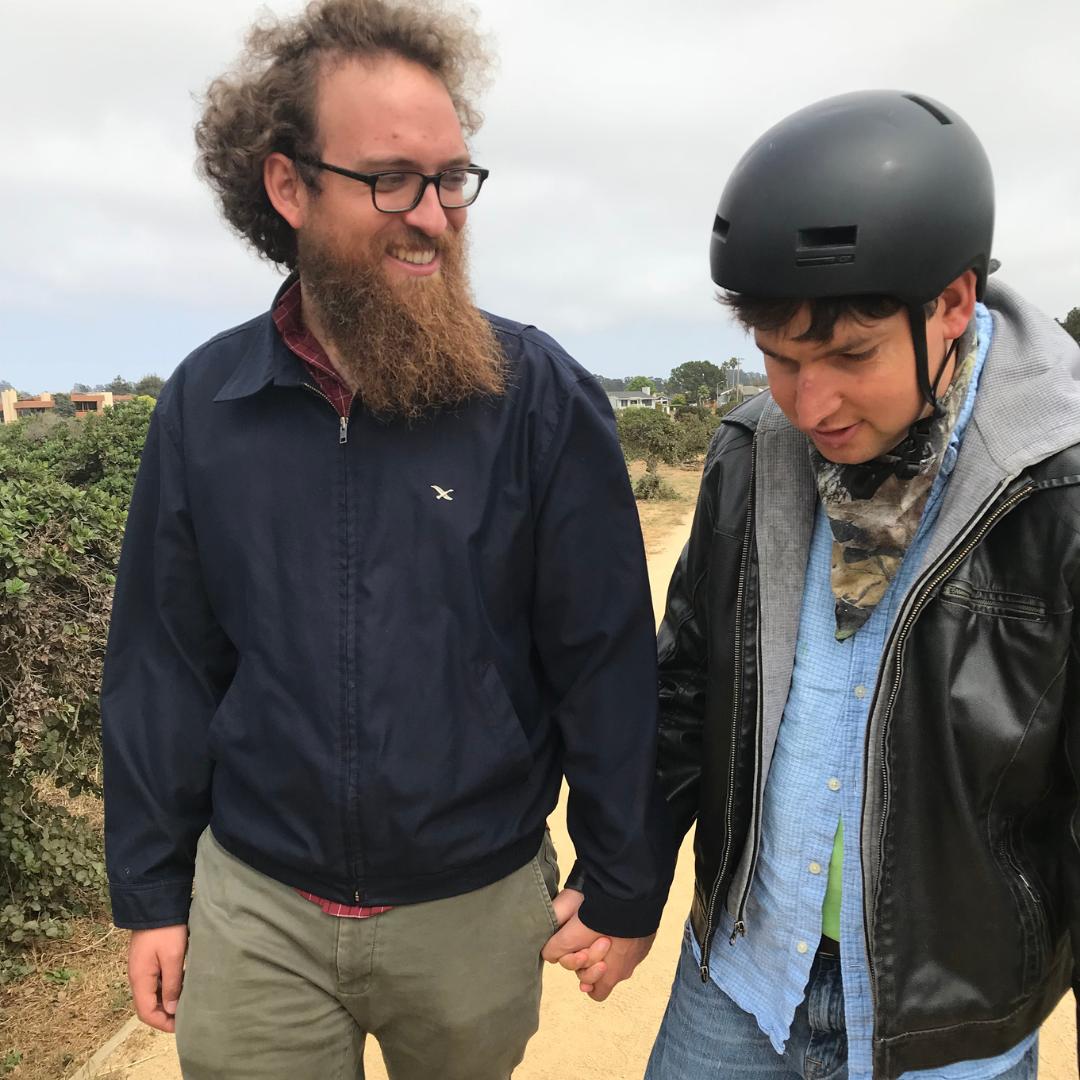
 For 42 years we assumed our beloved son Charlie was singular in his complex array of medical issues. It was only six months ago that we learned he belongs to a sliver of individuals with Lennox-Gastaut Syndrome. A simple notation made in Charlie’s chart by his neurologist was casually shared by a new primary care physician. A notation that had never before reached us.
It turns out that our world class epilepsy center uses different language to describe Charlie’s issues. In their world he has symptomatic generalized epilepsy. For seventeen years we were sadly unaware of the remarkable research and programs the LGS Foundation supports.
Charlie was one month old when a particularly bright shaft of light fell across his tiny face and I was startled to notice the strange, contrasting color of his eyes. In a shattering instant, I instinctively knew that one of his eyes was dying. That afternoon a pediatric ophthalmologist ruled out a brain tumor, but determined he had a microphthalmic (smaller) right eye with a retinal detachment.
A few weeks later after a scuttled initial surgery, Charlie’s retina was reattached. Under the care of a specialist we began patching the healthy eye in the hope of strengthening the weaker one. What none of Charlie’s physicians understood was the frequent correlation between eye abnormalities and neurological issues.
By three months, it was clear Charlie was developing slower than his peers. Physicians specializing in early intervention noted he was mildly behind his markers, but assured us he would likely catch up. Their mistake was the failure to arrange to monitor his progress.
By the time Charlie was a year old, my husband, Jules, and I knew something was amiss, so we enrolled him in an Easter Seals program. When Charlie was 18 months, a physical therapist shared concerns about a possible insult to the brain. The resident doctor recommended an MRI, but assured us we needn’t worry about seizures. Within a few weeks, I noticed Charlie staring absently into space. I knew immediately, he indeed had seizures.
Months later a neurologist slapped MRI scans under metal clamps and revealed that Charlie was missing over 200 million nerve fibers that connect the hemispheres of the brain. Moreover, he had a smaller left hemisphere, resulting in weakness and reduced function on his right side. Years later, a more sophisticated MRI would reveal frontal lobe abnormalities. But that day, the neurologist was reassuring as he firmly shook our hands at the end of the consult. “Charlie will tell you what to do.”
Jules and I were stunned. With such massive brain anomalies, how could anyone make so glib a comment.
The foray into anticonvulsants had begun with phenobarbital, turning our cheerful young son into an irritable, angry little boy. In the years that followed, Charlie’s seizure disorder became more complicated and severe. As for so many with Lennox-Gastaut, the following decades brought a tragic cascade of ineffective anticonvulsants; increased and varied seizures; and useless psychotropics intended to ease behaviors that instead caused serious side-effects.
With time it was clear Charlie would be significantly developmentally delayed. His speech was and still is perseverative, but we delight that he has language. Abstract concepts are not in the mix but in subtle ways he rhymes and juggles words to enliven the world. He spreads civility in the marketplace, urging folks at checkout to ask nicely for the money he proffers.
At seven years, Charlie was admitted to UCLA Medical Center for a brain resection that stilled his seizures for only nine months. He was assessed for a second surgery, but in 10 days of telemetry and video monitoring, he failed to have a single seizure. Further surgery was now out of the question. In subsequent years, there was a salivary gland resection, implantation of a vagus nerve stimulator and several hospitalizations to remove kidney stones caused by medication.
As Charlie turned nine, we made the crushingly difficult decision to send him across the country to the extraordinary Rudolf Steiner-inspired Camphill School in Pennsylvania. For 13 years he studied an adapted Waldorf curriculum, mucked stalls for the horses and nurtured the land on the gardening crew. There were unique student Shakespeare performances, the exploration of music and the weaving of willow baskets. But we only saw our son roughly seven times a year on visits to Camphill and back in San Francisco.
On graduation at 22, Charlie returned to California to live and work with gifted people who support him in his own home. A few days a week he is at Camphill California near Santa Cruz, where over the years he has woven scarves, taken part in plays and happily worked in the gardens with friends.
As the ravages of medications and seizures wear on his body, he begins to slow. A recent hospitalization for telemetry all but eliminated further surgeries, while his seizures and behaviors continue with sad frequency. The more seizure control a medication combination provides, the more frequent and disruptive his behaviors. We watch as he moves with greater difficulty, struggles with sleep and incontinence and copes with the blindness in his right eye. Yet one finds him out in the community shopping at Trader Joe’s, attending theater performances and traveling home to San Francisco with members of his team. It is a schizophrenic reality for those of us who love him.
Having now found the LGS Foundation, we are grateful for the gifted staff, the support groups they moderate and the friendship of other families. We have watched countless LGS recordings of professional presentations that have enabled us to better understand this challenging condition.
But, perhaps most of all, we value the LGS Foundation commitment to funding research. It is research that poses rigorous questions. Once answered, people with Lennox-Gastaut Syndrome will live fuller, less trammeled lives.
-Written and submitted by: Charlie’s Mom, Luise
Powering Breakthroughs: Tackling The 3 Grand Challenges in LGS
Every family living with Lennox‑Gastaut Syndrome knows how hard this journey can be—and how deeply we all dream of better answers and brighter days. That’s why the LGS Foundation is taking on the biggest barriers standing between families and a better future. This research initiative brings families, researchers, and care teams together to move us from seizures to full lives through precision diagnoses, precision treatments, and whole‑life care.
Updated 02/19/26 (KK)