
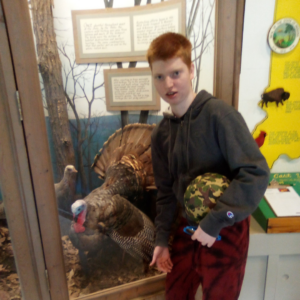
 Our journey with Lennox-Gastaut Syndrome (LGS) began on Thanksgiving Day in 2008, when my grandson Kameron was three years old.
My son-in-law called while rushing to the emergency room and said Kameron seemed unconscious, was making strange sounds, his eyes were rolling back, and at one point appeared to have stopped breathing. Upon arrival at the hospital, he was breathing but unresponsive.
Later that day, a staff member at the front desk described what she had witnessed that morning as “a panicked dad running in with a dead child.” Those words have stayed with our family ever since.
A few hours later, Kameron woke up. By that evening, his mother said he seemed back to normal.
Starting the very next day, the seizures began — and they kept coming.
Kameron experienced many types of seizures. At first, neurologists diagnosed him with Myoclonic Astatic Epilepsy, but his diagnosis was later changed to Lennox-Gastaut Syndrome. Testing detected more than 70 seizures in a single night.
Many combinations of anti-seizure medications were tried. Because he experienced frequent atonic, or drop seizures, sometimes every hour, Kameron wore a seizure helmet for protection. Dietary therapy worsened his condition.
He underwent two surgeries to completely remove the corpus callosum, the structure connecting the two hemispheres of the brain, but the seizures continued. At first, his Vagus Nerve Stimulator (VNS) also seemed to make little difference.
Over the past seventeen years, Kameron’s physical condition has had drastic ups and downs.
At four years old, there were times he had to be propped up just to sit. Three years ago, he was placed on life support, and attempts to remove his ventilator caused him to stop breathing.
Before epilepsy, Kameron was developmentally advanced for his age. Today, brain injury caused by uncontrolled seizures means he will live with severe intellectual disability. For a period of time, he also lost his short-term memory.
Through it all, he has continued to fight.
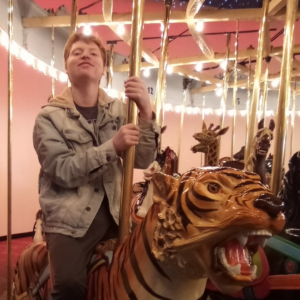 Today, a combination of treatments along with his VNS implant has reduced his tonic-clonic seizures to several per week. Overall, his physical condition is comparatively good. Unless we are somewhere that requires a lot of walking, he is often able to be out of his wheelchair.
His drop seizures have completely stopped.
Kameron enjoys shooting basketballs, throwing a football back and forth, and playing games and puzzles on the computer. Last summer, he participated in adaptive art lessons at Artmix. Each year, he eagerly looks forward to seeing Santa’s helicopter land at the State Museum.
Before epilepsy, he was known as our little red-haired wild man — tough as nails. That toughness has been a blessing.
Early in the progression of LGS, pediatric neurologists predicted his life expectancy might be about ten years and that he could eventually be in a vegetative state.
Last June, our Epilepsy Warrior turned twenty years old.
His high school held a private graduation ceremony where he received his Certificate of Completion — a moment our family will always treasure.
Every day with Kameron is a gift.
I tell him often that he is an angel sent to our family, and that we are the luckiest family in the world to have him in our lives.
Living with LGS has brought unimaginable challenges, but it has also brought deep love, strength, and gratitude. Kameron continues to remind us to celebrate every moment — because every moment matters.
-Written and submitted by: Kameron’s grandmother, Julie