
More Than a Meeting: Building Relationships
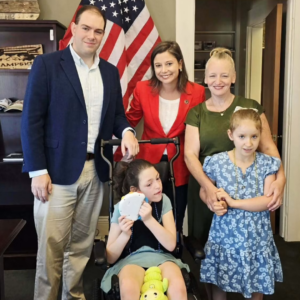 Have you ever wanted to talk to your members of Congress but weren’t sure where to start? The lessons learned from the LGS Advocates provide an opportunity to take that first step.
Every August, lawmakers return to their home states during the summer recess to meet constituents, hear our stories, and learn our legislative priorities as part of Rare Across America (RAA). The EveryLife Foundation for Rare Diseases offers multiple opportunities to make this accessible to all advocates, including first-timers. They train you, hand you the talking points, and schedule the meetings. No prior experience is necessary. This is your chance to share your story.
If you’ve never advocated before, joining the Advocates for LGS can be your on-ramp. Here’s what it looks like, and how you can participate in the future. (To join, contact Jennifer Griffin: jen@lgsfoundation.org)
Rare Disease Legislative Advocates (RDLA) sets you up for success:
A program of the Rare Foundation, RDLA offers trainings for first-time advocates and provides suggested “asks” – specific pieces of legislation to bring into your meetings. They also handle scheduling. This typically means two virtual meetings with your Senators’ offices and one in-person meeting with your House member (or their staff).
This Year, we had 4 recommended ‘asks’:
- Scientific EXPERT Act (H.R. 1532/S. 822): This bipartisan bill is designed to speed up the development and approval of treatments for rare diseases. It does so by creating a formal process for the Food & Drug Administration (FDA) to hold regular, collaborative meetings with medical experts, patient advocates, and drug companies.
- Access to Genetic Counselor Services Act (H.R. 6280/S. 3607): Currently, Medicare covers genetic testing but does not cover the professionals who help us understand the results. Hospitals and health systems struggle to employ counselors due to lack of reimbursement. This bill would recognize genetic counselors in the Medicare program and allow direct reimbursement for their services.
- Genomic Answers for Children’s Health Act (H.R. 7118): As many of our LGS families know, Medicaid coverage of genomic testing is a state-specific decision. This can cause significant delays in getting the right diagnosis and impact appropriate treatment. This bill makes it clear that genomic testing is a covered Medicaid service.
- Credit for Caring Act (S. 925/H.R. 2036): Did you know that 1 in 5 Americans are family caregivers? This represents $600 billion annually in unpaid labor. Family caregivers spend an average of $7200 annually in out-of-pocket expenses. This bill would allow eligible caregivers a tax credit up to $5000 for qualified expenses.
Have an ask of your own? RDLA encourages advocates to bring additional priorities into their meetings. For example, the Senate recently passed the National Plan for Epilepsy Act (S. 494/H.R. 1189), and it’s now waiting to advance through the House. That offered two opportunities: to thank the Senators and push the House to move.
What Actually Happens in These Meetings?
Every meeting looks a little different depending on group size. The Senate and House visits couldn’t be more different.
Senate meetings can be large, especially for the big states. In my California Senate meetings, we usually have 30-40 advocates participating. With only 30 minutes allotted, we organize ourselves ahead of time and appoint 1-2 speakers per ask. If you’re not one of the speakers, you’re not sidelined, since you can still share your story directly in the thank-you email that follows.
House meetings are much more intimate. In my most recent visit, I was the only advocate meeting with my Congressman’s staff representative, someone I’ve now met with three times. What was scheduled as a short visit ran almost 90 minutes. She committed to connecting with their legislative team and following up. Given her track record – the Congressman has supported nearly every ask I’ve made – I have no doubt she will be a supportive advocate for our community.
At the conclusion of the meetings, it’s always nice to request a photo with the staff member/representative. For the Zoom calls, we take a screenshot.
After thanking the staff member for their time, we leave behind one-pagers for each ask. This single-page document explains a policy issue, shares data, and asks decision-makers to act, providing a quick summary of the ‘ask’. (One tip: I also leave behind a one-pager sharing a bit about my son Theo and LGS. And of course, his picture is on that page. I want them to put a face to the disease.)
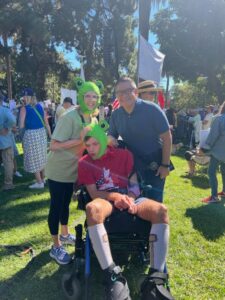 A Big Takeaway: This Is a Relationship, not a Transaction
Not every meeting will go this well, and that’s okay. The biggest lesson advocacy has taught me is that a single meeting isn’t the whole story. The relationship is! We won’t always get the outcome we’re asking for in the moment, but showing up repeatedly is what builds the trust that eventually moves things forward.
Advocacy isn’t about burning bridges or tearing down walls. It’s about working together, meeting after meeting, for our loved ones and our community.
To join the Advocates for LGS, please contact Jennifer Griffin – jen@lgsfoundation.org
You don’t need experience. You don’t need to be a policy expert. You just need to be willing to tell your family’s story, and then you’ll make a difference!
Updated 09/09/26 (KK)